Key Takeaways
- Sunlight is the cheapest and most effective way to break down excess sanitizer, often slashing readings dramatically within a few hours
- Testing with reliable strips or a liquid kit first prevents guesswork and wasted money on unnecessary treatments
- Partial draining and refilling with fresh water is a straightforward dilution method when levels spike extremely high
- Keeping pH between 7.2 and 7.6 helps stabilize sanitizer and avoids repeat overdosing
- Simply pausing tablet feeders or floaters and letting the water sit uncovered can resolve mild overages for free
- Hydrogen peroxide and sodium thiosulfate are low-cost neutralizers, but they must be dosed carefully based on test results
- Running the filter and swimming regularly both naturally reduce sanitizer without any product purchase
Why Your Pool Chemistry Suddenly Feels Off
You walked outside, dipped a test strip in the water, and the color practically screamed at you. The sanitizer reading is through the roof, maybe hitting 5, 8, or even off the top of the color chart entirely. Maybe your eyes sting after a quick swim, your skin feels itchy and tight an hour later, or that sharp, hospital-like smell hits you before you even open the gate. Your swimsuit might feel bleached out, or you notice the vinyl liner looks faded in spots. Something is clearly out of whack, and you want to fix it without spending a fortune at the pool store or hauling in a technician who charges by the hour just to tell you what you already suspect.
Here is the good news. Fixing an over-sanitized pool is one of the easier chemistry problems you can tackle at home, and it ranks near the top of the list of beginner-friendly pool care tasks. You do not need fancy gadgets, expensive additives, or a service technician in a branded polo shirt. In fact, some of the most effective solutions cost nothing at all beyond a bit of patience and sunshine. Mother Nature does a surprising amount of the heavy lifting here, and your filter, your pump, and even a simple garden hose can handle most of the rest. The whole process is less about chemistry wizardry and more about understanding a few basic principles and letting time work in your favor.
Before we get into the actual fixes, it helps to understand why this happens in the first place. Chlorine spikes are rarely random. They usually trace back to one of a handful of common culprits: a tab feeder cranked too high, a shock treatment that was heavier than the pool really needed, a floater left in the water during a cool stretch when demand dropped, or a stabilizer imbalance that made the chlorine stick around longer than expected. Sometimes it is a combination of all four. Knowing the cause matters because it directly shapes which of the budget-friendly solutions in this guide will work fastest for your specific situation.
This guide on how to lower chlorine levels in pool water starts from the absolute basics. If you have never balanced a pool before, do not worry. We will walk through everything in plain language, with no assumed knowledge about parts per million, oxidizers, or cyanuric acid. By the end, you will understand what caused the spike, how to bring the numbers back down safely, how to protect your pool surfaces and equipment in the meantime, and how to prevent it from happening again, all without draining your wallet or your pool.
What Chlorine Actually Does In Your Water
Chlorine is a sanitizer. Its job is to kill bacteria, break down algae, and neutralize the sweat, sunscreen, and body oils that swimmers leave behind. When added to water, it forms hypochlorous acid, which is the active germ-killing agent. Without it, your backyard oasis would turn green and murky within days.
The problem is that chlorine works on a sliding scale. Too little, and your water becomes unsafe. Too much, and it becomes harsh on skin, eyes, swimsuits, and even the pool liner itself. Health authorities recommend a free chlorine level between 1 and 3 parts per million for regular swimming conditions. Anything significantly above that is where trouble begins.
How Overdosing Usually Happens
Most spikes come from simple mistakes. You added too many tablets at once. You shocked the pool and swam too soon. A floater got stuck in one spot and dumped its payload. Rain washed stabilizer out, and your automatic feeder kept pumping. Understanding the cause helps you avoid repeat problems later.
- Overfilling an automatic chlorinator or floating dispenser
- Dropping in too many shock bags before a party
- Forgetting to remove tablets during a rainy stretch
- Using cal-hypo and dichlor interchangeably without adjusting dose
- Letting a saltwater generator run on too high a setting
How To Lower Chlorine Levels In Pool Without Spending Much
Before buying anything, test your water carefully. A cheap pack of test strips or a basic liquid kit will tell you exactly where you stand. Guessing is how people overdose a pool twice in a row, so take the two minutes to confirm the numbers. If your free chlorine reads above 5 ppm, it is time to act.
The simplest trick is pulling the lid off and letting the sun do the heavy lifting. UV rays break chlorine molecules apart quickly. According to Swim University, just a few hours of direct sunlight can reduce chlorine by up to 90 percent, which is remarkable considering it costs you nothing. Remove any solar cover, pause your tablet feeder, and let the pool bake uncovered during peak daylight.
Here is the easy playbook when you need to know how to lower chlorine levels in pool water fast and cheap:
- Remove all chlorine tablets, floaters, and automatic feeder cartridges immediately
- Pull back any solar cover, so sunlight hits the surface directly
- Run the filter continuously to help circulate and aerate the water
- Retest every few hours to track the drop
- Hold off on swimming until the reading falls within a safe range
Budget-Friendly Neutralizers When Time Is Short
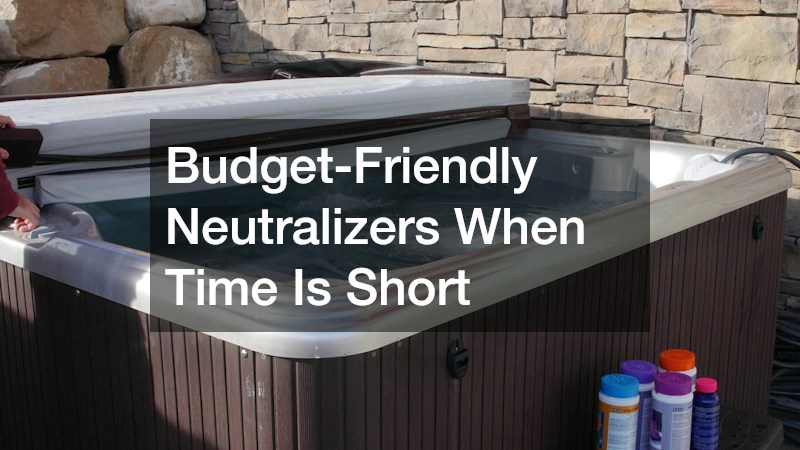
Sometimes you cannot wait for the sun. Guests are arriving, kids want in, and the reading still shows 8 ppm. In those cases, a chemical neutralizer is your friend. The two most affordable options are sodium thiosulfate and hydrogen peroxide, both of which you can find for a few dollars.
Sodium thiosulfate is sold as “chlorine neutralizer” at most pool supply stores. A small bag goes a long way, since you only need a tiny amount per 10,000 gallons. The trick is to add it gradually. Pour a small dose, wait fifteen minutes, retest, and repeat if needed. Dumping the whole bag in at once can crash your sanitizer to zero, which creates a whole new problem.
Hydrogen peroxide, the kind sold in bulk at hardware stores, also works. It reacts with chlorine and breaks it down into water and oxygen. Just make sure you are using a food-grade or pool-grade concentration rather than the tiny brown bottle from the medicine cabinet. For more ideas on stretching your dollar across the swim season, these affordable pool upkeep tips cover everything from DIY testing to seasonal shortcuts.
A Word On Measuring Doses
Underdosing is far safer than overdosing when it comes to neutralizers. Start with half of what the label recommends. Wait, test, and only add more if needed. This slow approach is the heart of smart pool care and keeps you from flipping the problem in the opposite direction.
The Old-School Dilution Method
If your reading is sky-high, like 15 ppm or more, chemicals and sunshine may take too long. The nuclear option is partial draining. Drop the water level by six to twelve inches, then refill with your garden hose. Fresh water dilutes the sanitizer concentration almost immediately. This method does use water, so check local restrictions and your bill, but for serious spikes it is often the fastest path back to normal.
Dilution also helps when your cyanuric acid, often called stabilizer, has climbed too high alongside your chlorine. Chlorine tablets contain stabilizer, so heavy tablet use pushes both numbers up together. A partial drain tackles both issues in one shot.
- Drain roughly ten to twenty percent of total volume
- Refill slowly to avoid stirring up debris
- Run the filter for at least eight hours after refilling
- Retest everything, including pH, alkalinity, and sanitizer
- Rebalance pH before adding any new sanitizer
Preventing The Next Spike Before It Happens
Once you have the numbers back in line, the real win is making sure you do not repeat the mistake next weekend. Prevention is almost always cheaper than correction, and it starts with a consistent testing routine. Check your water two or three times a week during swim season and once a week in the off months.
Balanced pH is a huge factor. According to Fluidra, keeping pH between 7.2 and 7.6 with proper filtration helps maintain sanitizer in a safe range and prevents the kind of overcorrection that leads to repeat overdosing. When pH drifts, chlorine either becomes less effective, prompting you to add more, or more aggressive, making readings look alarming.
Also remember that chlorine is naturally consumed over time. According to Poolonomics, most pools lose around 2 to 3 ppm of free chlorine daily through sun exposure, swimmer load, and organic debris. That natural burn-off is why automatic feeders exist in the first place, but it also means you can lean on it when levels run high. Simply skipping a dose or two often brings things back without any intervention at all.
Smart Habits That Cost Nothing
Building a few small routines into your weekly rhythm pays off all summer long. None of these require buying anything new, and most take less than five minutes.
- Rinse off before jumping in to reduce the organic load the sanitizer has to fight
- Pull floaters out before heavy rain is forecast
- Shock in the evening so sunlight does not burn off the dose before it works
- Keep a simple logbook of test readings to spot trends early
- Brush the walls weekly so algae never gets a foothold that demands extra sanitizer
When To Stop DIYing And Call Someone
Most overages are easy weekend fixes, but a few situations deserve a second opinion. If your sanitizer refuses to drop after sunlight, dilution, and a careful neutralizer dose, something else is likely going on. High cyanuric acid can lock chlorine into a form that resists breakdown. A malfunctioning salt cell may be dumping sanitizer regardless of what the control panel says. In rare cases, a stuck feeder valve keeps releasing tablets even when you think you shut it off.
Take a water sample to a local pool shop for a free full-panel test before spending money on a service call. The printout will show you cyanuric acid, calcium hardness, total alkalinity, and combined chlorine all at once. Armed with that information, you can decide whether the issue is something you can still handle at home or whether a technician needs to look at your equipment.
Conclusion
Bringing a sanitizer reading back down does not have to drain your wallet or your weekend. Between free sunlight, a working filter, a short pause on tablets, and the occasional small dose of a cheap neutralizer, almost every overdose situation can be resolved with items you already own or can grab for a few dollars. The key is testing first, acting gradually, and resisting the urge to throw more product at the problem.
Prevention is where the real savings live. A balanced pH, a consistent testing schedule, and a watchful eye on your feeder or salt cell will spare you from most future spikes entirely. Small habits like rinsing before swimming and pulling floaters before storms add up to fewer corrections and lower chemical bills across the season.
Treat your pool like any other system in your home. Pay attention to the small signals, respond with the lightest touch that works, and lean on the free tools first. Do that, and you will spend far more time floating in your backyard than fussing over test strips.